
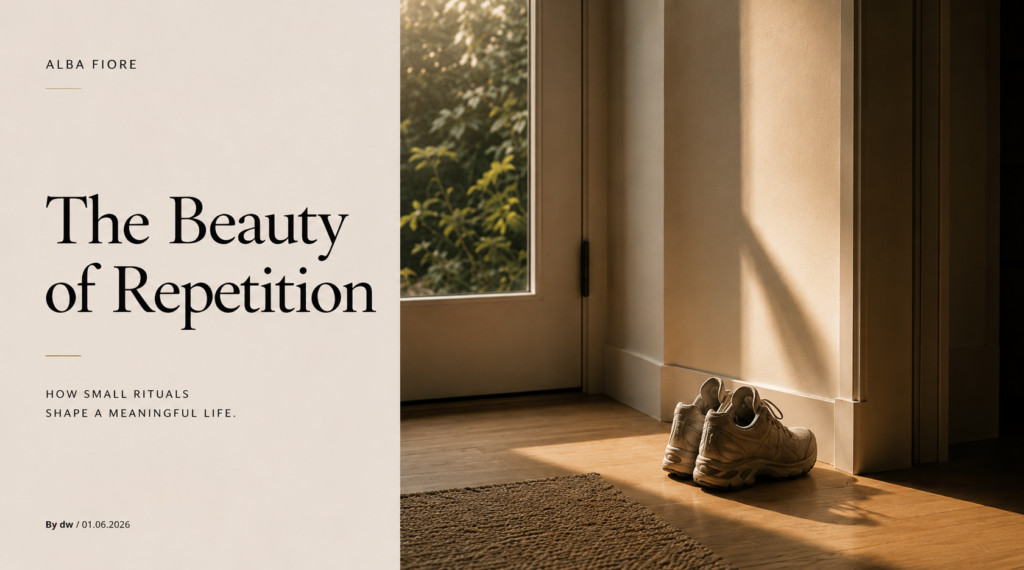
Small rituals. Quiet habits. Ordinary actions repeated so often that we stop noticing them.
Modern culture celebrates novelty. We are encouraged to seek new experiences, new destinations, new goals and new versions of ourselves. Change is often presented as the primary path to growth.
Yet when we look closely at the lives we admire most, a different pattern emerges.
Meaningful lives are rarely built through dramatic transformations. More often, they are built through repetition.
The morning walk. The daily swim. The notebook opened every evening. The same route. The same movement. The same ritual.
Not because life lacks imagination, but because repetition creates depth.
The Hidden Power of Ordinary Habits
A single workout changes very little. A single page written in a notebook is almost insignificant. One healthy meal rarely transforms anything.
But repeated over weeks, months and years, these actions become something larger than themselves.
They become identity.
We often think habits create results. In reality, habits create people.
Someone does not become a runner because they complete a race. They become a runner when putting on their shoes becomes a normal part of life.
The same is true for writers, swimmers, artists, leaders and parents.
Identity is not formed by occasional achievements.
It is formed by repeated actions.
Repetition Creates Calm
There is another benefit that receives less attention.
Repetition reduces noise.
In a world filled with constant choices, routines remove unnecessary decisions. When certain actions become automatic, energy is preserved for the things that truly matter.
The most effective people are often not those with the most complicated systems.
They are those with a few simple rituals they trust.
A morning routine. A movement practice. An evening reflection. A weekly walk.
Small anchors that create stability regardless of what happens around them.
Repetition becomes a form of calm.
Why We Resist It
The challenge is that repetition rarely feels exciting.
Progress is difficult to see in real time. The first ten days feel almost identical. The first hundred repetitions often appear ordinary.
We crave visible change.
We want immediate evidence that our effort matters.
Yet many of the most valuable processes in life are invisible while they are happening.
A tree grows quietly.
Trust develops slowly.
Strength accumulates gradually.
Meaningful work compounds over time.
The beauty of repetition is that it asks for patience.
A Different Definition of Growth
Perhaps growth is not always about becoming someone new.
Perhaps it is about returning, again and again, to the things that matter.
The same book.
The same practice.
The same values.
The same commitment.
Not because we are stuck, but because some things become more meaningful the longer we stay with them.
The people who appear calm, grounded and intentional are rarely relying on motivation.
More often, they are relying on repetition.
They simply continue.
One day.
Then the next.
Then the next.
And eventually, what once felt like effort becomes part of who they are.
That is the beauty of repetition.
Not that it changes a single day.
But that, over time, it changes a life.