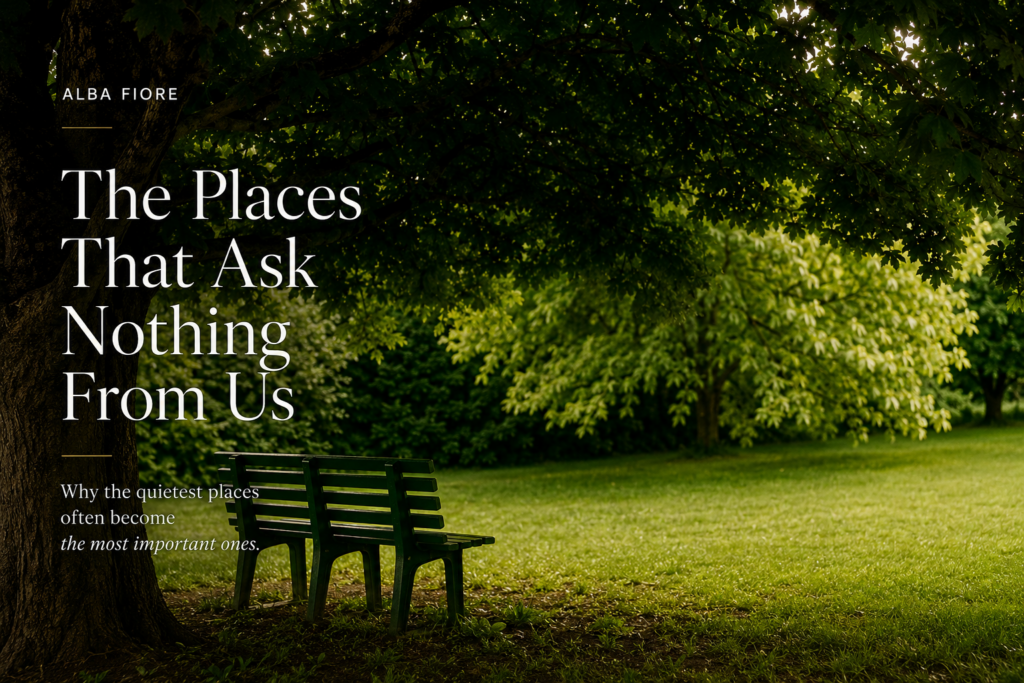
Why the quietest places often become the most important ones.
There are places we travel to, and there are places we return to.
Modern culture celebrates discovery. We are encouraged to seek new destinations, new experiences and new stories to tell. Travel has become a way of collecting moments, often measured by how different they are from what came before.
Yet when we look closely at our own lives, the places that matter most are often not the ones that surprised us. They are the ones that remained.
A bench beneath a familiar tree. A path we know by heart. A quiet park at the edge of a city. A café where nobody knows our name, yet everything feels strangely familiar.
These places rarely appear in travel guides. They are not destinations. They do not compete for our attention. And perhaps that is precisely why they become important.
The Places That Do Not Demand Anything
Many environments ask something from us. Workplaces ask for performance. Social media asks for visibility. Cities often ask us to move faster. Even leisure has become increasingly productive. We track our workouts, optimise our routines and search for ways to improve every moment of our lives.
The result is a world that constantly asks for something: more attention, more effort, more ambition and more output.
Against this backdrop, certain places offer something increasingly rare. Nothing.
They do not ask us to buy anything. They do not ask us to achieve anything. They do not ask us to become a better version of ourselves. They simply allow us to exist.
A quiet place does not improve us through instruction. It restores us through permission: permission to slow down, permission to observe and permission to be present without purpose.
The Comfort of Returning
We often associate meaning with novelty. Yet some of the deepest forms of meaning emerge through repetition.
Returning to the same place changes the relationship we have with it. The first visit is an introduction. The second is recognition. The third becomes familiarity. Over time, the place becomes part of our personal landscape.
We begin to notice details that were invisible before. The way light falls through the leaves at a particular hour. The sound of the wind before rain arrives. The rhythm of people moving through the space. The subtle changes between seasons.
What was once simply a location slowly becomes a companion. Not because it changes dramatically, but because we do.
Places That Know Us
There is something comforting about being known. We usually think of this in relation to people. Yet certain places know us too.
Not literally, of course. But through repetition, they become witnesses. They have seen us arrive tired. They have seen us arrive hopeful. They have seen us return after difficult weeks and joyful ones.
Without judgement. Without expectation. Without questions.
This may be why we instinctively return to certain places during periods of uncertainty. Not because they provide answers, but because they provide continuity. In a world that changes constantly, continuity becomes a form of comfort.
Presence Instead of Productivity
One of the great paradoxes of modern life is that we spend so much energy trying to improve our wellbeing that we sometimes forget to experience it.
The most restorative moments rarely arrive when we are actively pursuing them. They arrive unexpectedly: sitting quietly beneath a tree, watching reflections move across water, walking without a destination, listening to sounds that ask for nothing in return.
These moments appear insignificant. Yet they often remain in our memory longer than far more dramatic experiences. Not because they were extraordinary, but because we were fully present when they happened.
Choosing What We Return To
Perhaps the quality of a life is shaped not only by what we pursue, but also by what we return to.
The book we read again. The conversation we continue. The street we walk repeatedly. The place where our thoughts become quieter.
These choices gradually become part of who we are. Not through intensity, but through repetition. Not through novelty, but through familiarity.
The places that ask nothing from us rarely demand our attention. They simply wait.
And when we return, they remind us that not everything valuable needs to be new.
Sometimes the most important places in our lives are the ones that never asked for anything at all.
They were simply there, waiting for us to come back.