
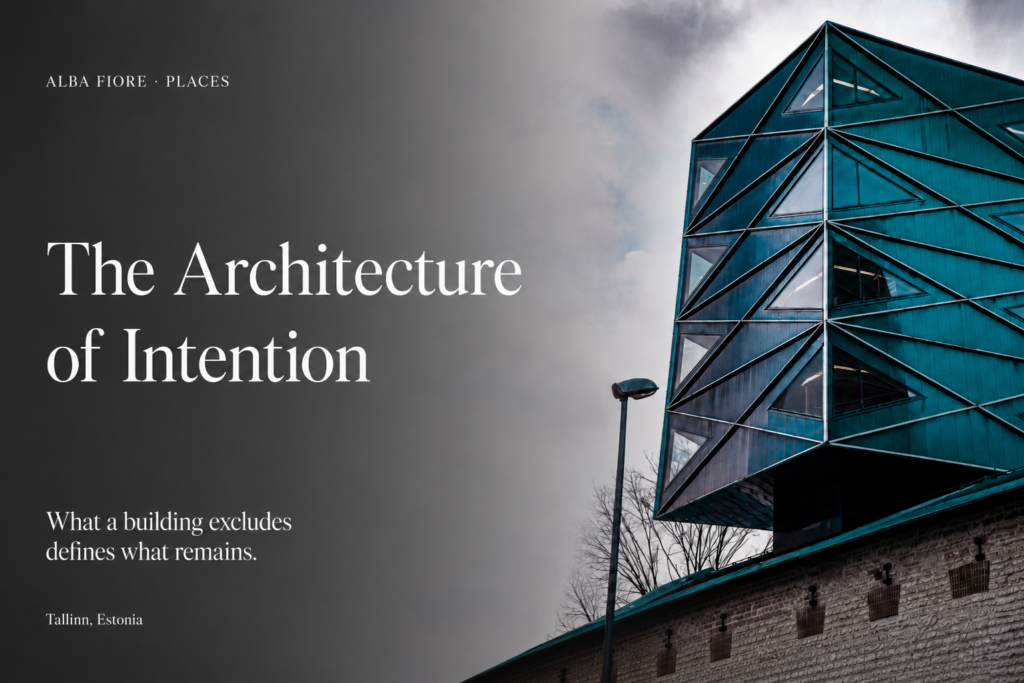
Not every building asks to be admired. Some ask to be understood.
Standing before this façade in Tallinn, the first impression is not its height or its colour. It is the quiet precision of its geometry. Every angle appears considered. Every line seems to belong exactly where it is. Nothing feels decorative. Nothing feels accidental. The building does not compete for attention — it communicates intention. And there is a difference between the two that becomes legible, once noticed, in almost everything one looks at afterwards.
Perhaps this is why certain works of architecture remain with us long after we leave them. Not because they are louder than everything around them. Because they express a clear idea without unnecessary explanation — because the thinking that produced them is still visible in the result, not as ornament but as structure.
Every meaningful building begins not only with what is included, but with what is deliberately left out.
This is the part of architecture that is hardest to see from the outside, because what has been removed leaves no visible trace. The space that was protected from distraction, the detail that was considered and rejected, the decision to allow one material to do its work without the interruption of another — none of this is present in the finished building. And yet all of it is responsible for what the finished building feels like. The coherence of a well-designed space is the accumulated consequence of decisions that are no longer visible.
Tallinn’s most memorable buildings are not those trying hardest to distinguish themselves. They are the ones that know precisely what they are trying to express — and that have had the discipline to remove everything that would have diluted that expression. Walking through the city, this becomes surprisingly easy to see. Confidence, in architecture as elsewhere, rarely needs decoration. It needs coherence. The buildings that stay with you are the ones in which every element is doing something necessary, and nothing is doing something merely permitted.
Perhaps this is why architecture has so often served as a quiet metaphor for other kinds of making.
A life built with intention follows a similar logic — not the logic of accumulation, but the logic of selection. Not what can be added, but what deserves a place. The calmest lives are not necessarily the least busy. They are often the most coherent — the ones in which what is present is there for a reason, and what is absent has been deliberately left outside. That kind of restraint is frequently misread as simplicity. In reality, simplicity is almost always the visible surface of countless decisions that happened before anyone was looking — decisions about what mattered enough to keep and what needed to go.
This is what a building like this one in Tallinn makes unexpectedly visible. Not a lesson about how to live — architecture does not lecture. But a quality of attention made physical: the evidence that someone thought carefully about what this thing should be, and had the discipline to build only that, and nothing more.
The most lasting impression it leaves is not aesthetic. It is the quiet recognition that intentionality has a particular appearance — and that appearance, once seen, is difficult to mistake for anything else.


