
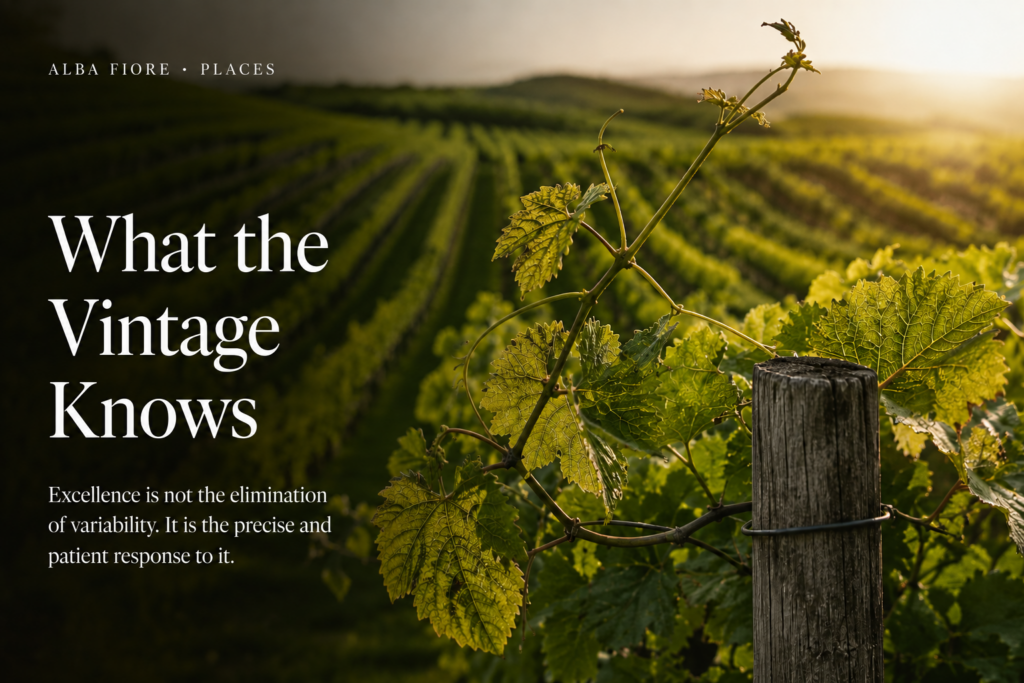
There is something quietly instructive about a vineyard.
At first glance, very little seems to happen. The rows remain still beneath the changing light. The landscape appears almost unchanged from one day to the next, as though time itself had slowed to match the rhythm of the vines. Yet beneath that apparent stillness, everything is unfolding — roots deepening, branches strengthening, fruit forming gradually and almost invisibly, every season leaving its mark long before the harvest gives any visible sign of what has been taking place.
This is not patience in any passive sense. It is precision. The vineyard is not waiting — it is working, continuously and without urgency, toward a result that cannot be forced without being diminished.
There is a particular quality that distinguishes a great vintage from a merely good one, and it has nothing to do with the intention of the people who tend the vines.
It has to do with the conditions of that specific year. The particular distribution of rain and sun. The temperatures of specific weeks. The timing of the first frost. A year of drought produces a different wine than a year of abundance — not a worse one, necessarily, but a different one, shaped by pressures that left their mark in ways that only become fully legible in the glass, sometimes years later. The winemaker’s skill is not the ability to produce the same result regardless of conditions. It is the ability to understand what a particular set of conditions makes possible — and to work precisely within them rather than against them.
No two vintages are identical. No great winemaker would want them to be.
This is not how we usually think about excellence.
We tend to imagine it as the consistent reproduction of a standard — the same quality, maintained regardless of circumstances. We speak of reliability, of systems, of processes designed to eliminate the variability that conditions inevitably introduce. There is value in that. But it describes a different kind of excellence than the kind a vineyard produces — one that is optimised for consistency rather than for the particular possibilities of a particular moment.
The excellence of a vintage is inseparable from its year. The wine that comes from a difficult season carries something that a wine from an easy season cannot — the particular character that emerges when a living system has had to work harder, adapt more precisely, draw more deeply on its own resources. The difficulty is not incidental to the result. It is part of what the result is.
Perhaps this is why the language of wine has always been so closely related to the language of character. We speak of a wine’s depth, its complexity, its persistence — qualities that are not manufactured but developed, over time, through conditions that could not have been predicted or controlled, only navigated.
A vineyard does not become impatient because another vineyard ripens first. It does not force the harvest before the fruit is ready, knowing that what is gained in speed is lost in everything that makes the result worth having. It understands — in the wordless way that living systems understand things — that every season has its own work to do, and that the work of one season becomes the foundation for the next.
What a vineyard cannot do is produce a great wine from a year that did not happen. It can only work with what a particular combination of soil, climate and time actually offers — and find, within those specific conditions, what is possible that would not have been possible in any other year.
There is a form of intelligence in that. Not the intelligence of control, but the intelligence of responsiveness — of reading conditions precisely and working within them rather than attempting to override them.
The things that endure are rarely those that were produced by forcing an outcome. They are almost always those that emerged from a precise relationship between intention and condition — from someone who understood what a particular moment made possible, and had the patience and the skill to let that possibility develop at its own pace.
A great vintage cannot be rushed. It can only be recognised — and given the conditions it needs to become what it already, in some sense, is.
Perhaps that is what the vineyard knows that we sometimes forget. That excellence is not the elimination of variability. It is the precise and patient response to it.


