
Some places become important so quietly that we hardly notice when it happens.
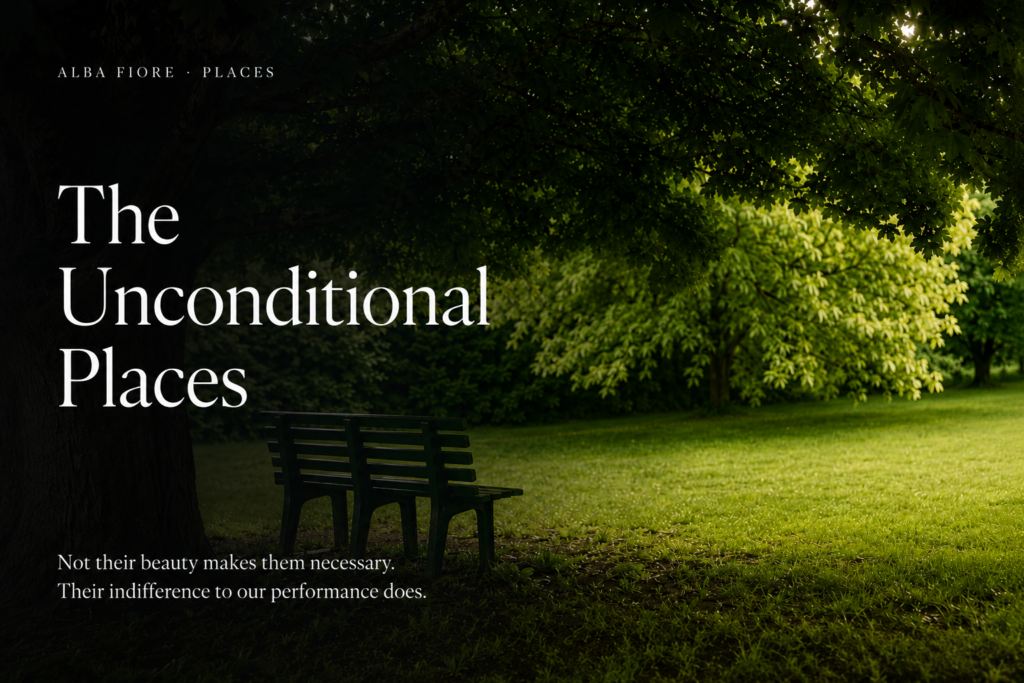
They are rarely the places we once dreamed of visiting. They do not appear on postcards or travel itineraries. They ask for very little and offer nothing that can easily be described to someone who has not been there. A bench beneath an old tree. A familiar path through a park. A corner of a city where nothing remarkable ever seems to happen. Yet somehow we find ourselves returning — not because there is always something new to discover, but because there is something deeply reassuring about what remains the same.
The places that shape us are not always the ones that surprised us. More often they are the ones that welcomed us back, again and again, without requiring us to be anything in particular when we arrived.
Perhaps this is the quality that distinguishes certain places from others — not their beauty or their history or their capacity to impress, but their complete indifference to our performance.
A bench beneath a tree has no expectations. It does not require us to have made a good decision recently, to be moving in the right direction, to have resolved the question we were carrying when we sat down. It offers no reward for ambition and no judgement for the absence of it. It simply makes room. And in making room without conditions, it offers something that is surprisingly difficult to find in most of contemporary life — the experience of being somewhere without also being assessed for being there.
We underestimate how much of ordinary life involves some form of performance. Not the dramatic kind, but the continuous low-level kind — the monitoring of how we appear, the managing of how we are received, the quiet effort of presenting a version of ourselves that is adequate to whatever the moment requires. Most environments participate in this. They have expectations, even when those expectations are unstated. The workplace has them. Social occasions have them. Even rest, in many contexts, has been quietly annexed by the logic of productivity — useful rest, restorative rest, rest that makes us better at everything else.
The unconditional places resist that logic entirely. They do not participate in the economy of assessment. And the relief this produces is not the relief of escape. It is something quieter — the relief of being, for a moment, simply present rather than accountable.
Over time, these places accumulate a particular kind of significance.
Not because extraordinary things happened in them, but because ordinary things happened often enough that the place became a witness to a life. It has seen us arrive full of hope and weighed down by disappointment. It has seen us distracted and grateful, certain and lost. Nothing about the place remembers those moments — a park has no memory, a bench keeps no record. Yet something in us does. And returning to a place that was present for earlier versions of ourselves produces a continuity that is difficult to find elsewhere — the sense that the person who sat here before and the person sitting here now are part of the same story, even when they feel, from the inside, remarkably different.
This may be why we return to the same places during uncertain seasons of life. Not for the view or the fresh air, though we tell ourselves it is for those things. But for the experience of continuity itself — the quiet confirmation that something has remained constant while everything else was changing.
The world beyond the park continues exactly as before. The deadlines remain. The unanswered messages are still waiting. Nothing outside has become easier.
Yet we often leave feeling different. Not because the place resolved anything. But because the absence of demand created enough space for something to settle that the rest of the day had been keeping in motion. The place did not change the situation. It changed the person returning to it — which turns out, often enough, to be sufficient.
Perhaps this is what the unconditional places have always offered. Not transformation. Not answers. Simply enough stillness for things to find their own proportion — and enough unconditional presence for us to remember, without being told, that we are capable of finding ours.


