
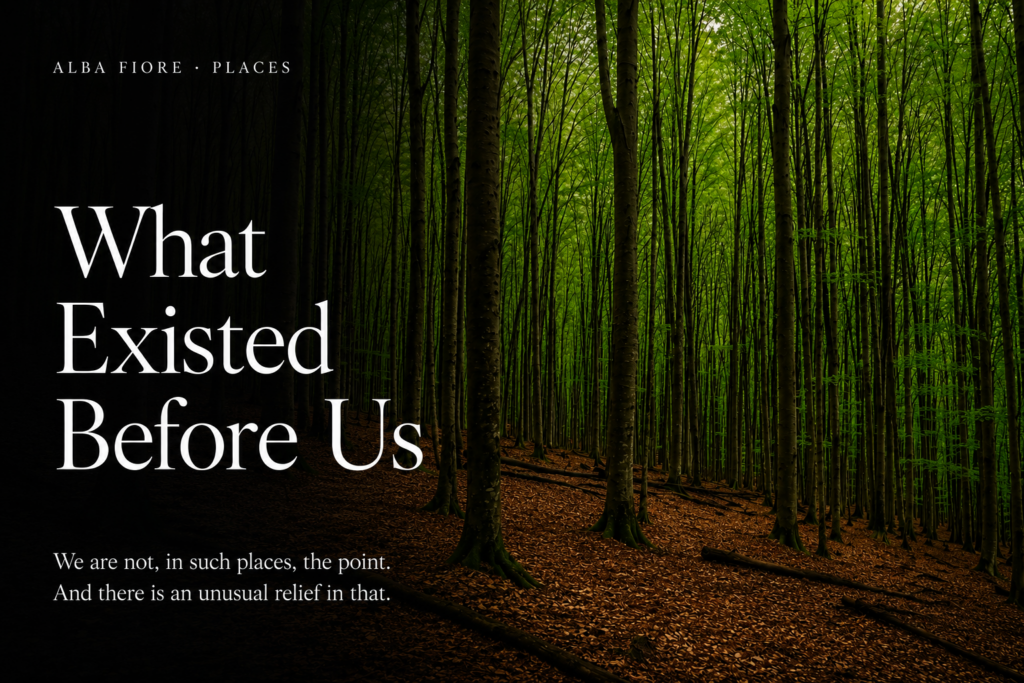
Not hostile — indifferent. They do not ask who we are, what we have achieved or what we hope to become. They offer no recognition for our ambitions and no consolation for our failures. They simply exist, quietly and completely, as they did before we arrived and as they will continue to do long after we have gone.
A forest is one of those places.
Standing beneath tall trees, the first thing that changes is scale. The trunks rise beyond our field of vision until they disappear into the canopy. The light that reaches the ground has passed through layers of leaves, each one turning it into something softer and more diffuse than the light that fell on the canopy above. The branches that are moving now were moving before we got here. The roots that hold these trees reach into soil that has been accumulating for centuries. We have arrived in the middle of something that has no particular interest in our arrival.
This is not a small thing.
Most of the environments we inhabit have been designed, in some sense, around us.
They respond to our presence. They anticipate our needs. They offer feedback — explicit or implicit — about how we are doing, how we appear, whether our use of the space is adequate. Even the natural environments we most commonly encounter have often been shaped to accommodate us: paths cleared, viewpoints marked, distances measured and posted. The experience of being in a place that is genuinely indifferent to whether we are there at all has become, for many people, genuinely unusual.
A forest that has not been arranged for visitors offers something different. It is not performing. It is not waiting. It existed before the particular concerns we brought with us, and it will continue existing after we leave with or without having resolved them. There is a quality of presence in very old things — in trees that were already large before we were born, in root systems that predate anything we have built — that has nothing to do with beauty. It is the quality of something that simply is, without reference to anything outside itself.
We are not, in such places, the point. And there is an unusual relief in that.
Perhaps this is why time moves differently in a forest.
Not slowly, exactly — but without the particular quality of urgency that structures most of our days. The urgency of modern life derives largely from responsiveness: the sensation that something is always waiting for an answer, that our attention is always owed somewhere. A forest makes no such claim. The sound of wind in the canopy is not asking to be acknowledged. The particular quality of light at a certain hour is not waiting for a response. These things are simply occurring, as they have always occurred, in the complete absence of any expectation that we should do something about them.
What this creates — and it takes a little time to arrive, because the habits of responsiveness do not release immediately — is something close to the experience of existing without obligation. Not the forced relaxation of a scheduled break, but the more genuine quietness of being somewhere that has no investment in what we do next.
The forest was here before the question we are carrying. It will be here after we have answered it, or abandoned it, or forgotten what it was. That continuity — the sheer fact of something that extends beyond our particular moment in it — has a way of returning proportion to things that had quietly grown beyond their actual size.
When we leave, the forest remains exactly as it was.
Nothing about our visit has changed it. The trees that were reaching toward the light when we arrived are still reaching. The particular silence between sounds — not silence exactly, but the absence of demand — continues without us. We took nothing with us except, perhaps, a slightly different sense of the scale of things.
That may be enough. Because what a forest offers is not restoration in any strategic sense. It is not designed to make us more productive or more resilient or more anything in particular. It simply exists at a scale and a duration that makes our own scale and duration feel, briefly, more accurately sized.
And sometimes that is precisely what is needed — not answers, but proportion. Not silence, but the company of something that existed long before our questions began.


